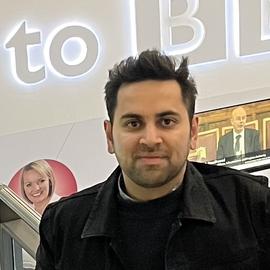
Biography
I received my PhD degree from Computer Science Department at University of Warwick in 2020. My research topic centered around developing neural models for the task of stepwise text illustration. Prior to this, I received my Bachelors degree (2015) in Computer Science and Engineering from Indian Institute of Technology Ropar, India.
I have been part of the NLP research group. My primary research interests include semantics, joint representation of images and texts. I am continuously working towards developing Machine Learning and Deep Learning based solutions for many tasks lying at the intersection of Natural Language Processing and Computer Vision. Besides my primary research-area of natural language processing, I also work on data mining and knowledge graphs. I actively do industrial collaborations and worked previously in the ecommerce sector as a Software Development Engineer.
- Artificial Intelligence
- Natural Language Processing
- Machine Learning
-
PhD in Artificial Intelligence (NLP), 2020
University of Warwick
-
BTech in Computer Science and Engineering, 2015
Indian Institute of Technology Ropar
Experience
Responsibilities include:
- investigated the inclusion of latent random variables in recurrent neural network architectures for the tasks involving highly structured sequential data, mainly textual

Responsibilities include:
- worked with medical reports data on long document representation. Open-source software like Octave to automatically detect handwritten text was used.

Responsibilities include:
- worked on the development of a visualisation tool for a probabilistic modeling framework based on Latent Dirichlet Allocation (LDA), called joint sentiment-topic model (JST), which detects sentiment and topic simultaneously from micro-blogging services.

Responsibilities include:
- worked on developing a simulation framework for a multidisciplinary solution based on the consideration of the so-called small world dynamics which have been proposed for economy and social studies and have recently revealed to be a successful approach to be exploited for characterising information propagation in social networks
Contact
- vishwash@tutanota.com
- CR121, Colin Reeves, Keele, Staffordshire, ST5 5BG
- Enter Collin Reeves Building on second floor
-
Monday 10:00 to 13:00
Wednesday 09:00 to 10:00 - Book an appointment
- DM Me
- Chat on Keybase
- Discuss on Forum